The DICRIM YOUR ESSENTIAL DOCUMENT
The Local Information Document on Major Risks (DICRIM) sets out the risks in Val d’Isère and the guidelines to be followed. It is the reference document that should be consulted and kept for future reference.

Img 6365
|
The Local Information Document on Major Risks (DICRIM) sets out the risks in Val d’Isère and the guidelines to be followed. It is the reference document that should be consulted and kept for future reference.
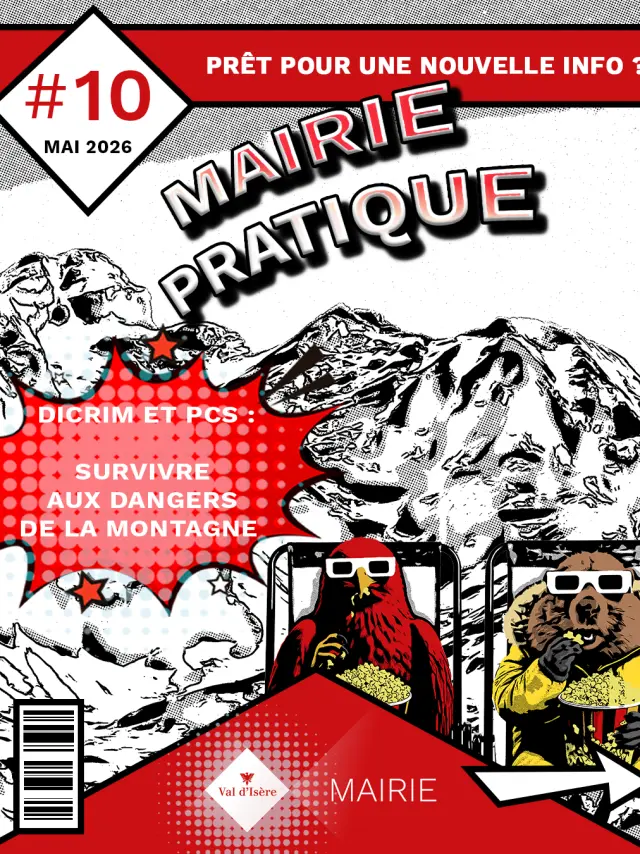
The ‘Mairie Pratique’ series explores a local government topic each month in comic-strip form. Issue 10 introduces you to the DICRIM, the PCS and the ‘Vivre à Val d’Isère’ app.
1st Cover Insta Format
Val d’Isère is situated in a high-mountain area, at the bottom of a valley. Thirteen major hazards have been officially identified within the municipality, divided into three categories.
Even before an incident occurs, you can take steps to protect yourself.
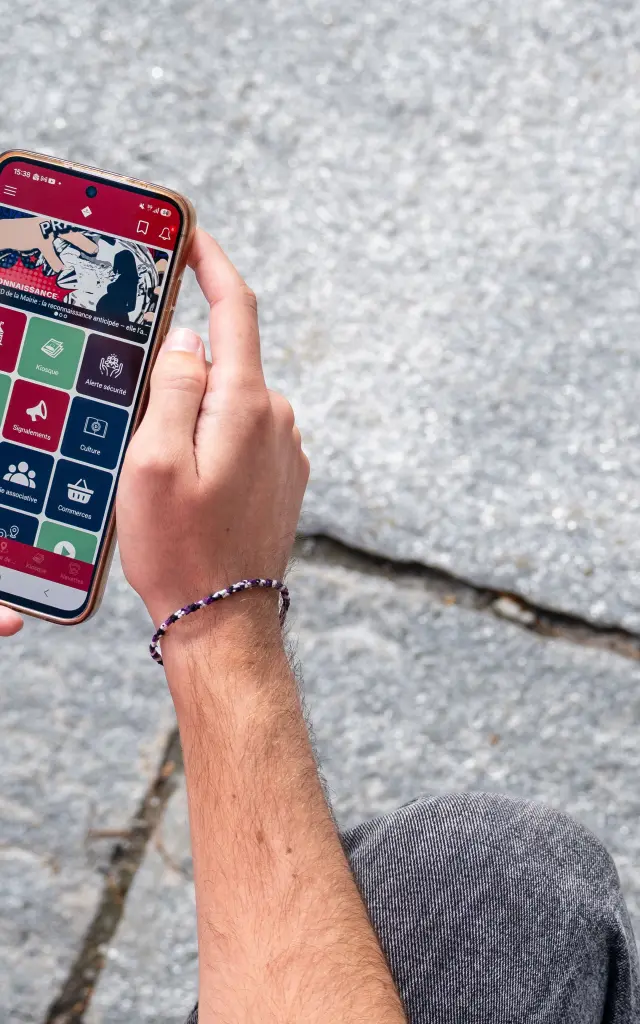
📱 This is the local council’s priority alert channel. The ‘Vivre à Val d’Isère’ app alerts you in real time in the event of a serious incident: direct, location-based notifications sent to your smartphone, with no registration required. Simply download it.
A few simple items to gather from around your home, within easy reach, in the event of a lockdown or evacuation.
The PFMS enables everyone to organise in advance the tasks to be carried out in response to each risk, for their immediate circle: planning, crisis management and speeding up the return to normality. It complements the DICRIM and the PCS. The document is available from the town hall on request.
📱 ‘Vivre à Val d’Isère’ app — priority channel: push notifications and updated guidance throughout the event. The fastest and most accurate channel. No registration required; simply download the app.
📞 Text messages, calls, email: The local council operates a service for sending pre-defined messages. To use this channel, you must have registered in advance with the town hall.
📡 FR-Alert: Automatic mobile alerts sent to all phones in the affected area, with no prior registration required. A national system activated by the prefecture.
📢 SAIP siren The local authority is equipped with a SAIP siren to alert the public. A test is carried out on the first Wednesday of every month at 12.15 pm.
📣 Loudspeaker and megaphone Alert information may be relayed by a team patrolling the municipality.
🔔 Alarm bell The church alarm bell may ring at unusual times for several minutes to warn of an incident.
🌐 Website: mairie-valdisere.fr An alert banner on the homepage and a ‘Risks and Alerts’ page updated in real time.
📻 Radio Val d’Isère — 96.1 FM The town’s official radio station, it broadcasts local news, instructions and weather updates during the event.
In Val d’Isère, two points of contact trigger the alert depending on the nature of the incident:
For large-scale events, the Prefecture may also activate FR-Alert across the entire affected area.
Established in 2022, the municipal civil protection reserve brings together volunteers from Val d’Isère who can be called upon by the town hall during events that exceed its usual capacity. Their role is to support the local population, assist with logistics and help restore normality.
Joining the Municipal Reserve The reserve is open to any adult resident of Val d’Isère who possesses the physical and mental capacity required for the tasks involved. No prior training is required: information sessions are provided for volunteers. The commitment is for one year, automatically renewable for a maximum of five years.
📬 How do you become a reservist? Download the commitment form, complete two copies, and send them to the Mayor.
The Local Emergency Plan (PCS) is the operational tool that enables the council to coordinate emergency response in the event of a crisis. It identifies risks, sets out the actions to be taken, and mobilises human and material resources. It may be activated by the mayor or by the person acting in their place.
In 2024, the local authority completed a comprehensive update of its PCS, a process that had been underway since 2023. This review involved all municipal departments and security partners. It enabled the incorporation of lessons learnt from recent years and the modernisation of tools, notably through the roll-out of geolocated alerts via the ‘Vivre à Val d’Isère’ app.
PCS and DICRIM: two complementary tools The PCS is the local council’s internal tool: it sets out what departments are to do in the event of a crisis. The DICRIM is the document intended for residents: it sets out what you need to know and do. Both are required by law (Articles L.731-3 of the Internal Security Code and R.125-11 of the Environment Code).
This page and the documents to which it refers fall within the scope of Articles L.125-2 and R.125-11 of the Environment Code (right to information on major risks) and Article L.731-3 of the Internal Security Code (municipal emergency plan).
Prevention and Safety Department
Val d’Isère Town Hall
50 Montée du Thovex
04 79 06 01 60
In an emergency: 112 (single European emergency number)