What they’re saying: read the full testimonials
Tiphaine Duperier – Mountain guide
‘If we consider ecology in the usual sense of the word, this philosophy aims to improve the balance between humans and their natural environment, as well as to protect it. Instinctively, I feel a close connection to this way of thinking and acting. My core profession, my passion, is directly linked to our environment, and so committing to its protection is a vital priority. To try and play my part in this protection on a day-to-day basis, I’ve focused on my consumption habits: buying locally, responsibly, and with as little packaging as possible. My scope for action is limited because my biggest step would be to reduce my travel, but as a High Mountain Guide, I must admit the situation is complicated.
This issue raises many contradictions: how can we reconcile tourism with environmental protection? I travel for work, and as I live in Villaret du Nial, it’s difficult to significantly reduce my journeys. I make my living from tourism, and this sector is responsible for 11 per cent of greenhouse gas emissions*, and these emissions contribute to global warming and, consequently, to a lack of snow, which threatens my livelihood. What we also know is that these emissions are mainly linked to the transport of people to our resorts (57%*). According to the statistics, 31%** of GHG (greenhouse gas) emissions come from the transport sector, with more than half of these coming from private cars. This is a good start, as it identifies a clear area for action!
To have a tangible impact on these emissions and thus strike a balance with our environment, we need to rethink our economic fabric. To reduce travel, people should be able to do their shopping locally, the majority of local residents should be able to live in the resorts themselves, and public transport should be developed. It is now up to mountain communities to keep their residents at the heart of the resorts, as the stakes are high both environmentally and socially.”
*Source: Ademe “Assessment of GHG emissions from the tourism sector in France”, April 2021 – 2018 data, groupe-ecomedia.com
**Source: CITEPA, Secten 2020 report, notre-environnement.gouv.fr”
André Legrand, resident of Val d’Isère
“Sustainable development is an important issue, but we must be careful – there are pros and cons to how we approach it. Carrying out development projects is fine if done properly, but if it’s a half-hearted effort, what’s the point of spending so much? Take the Prariond works, for example: yes, the road has been improved, it’s better to drive on, but what about the buses that can barely stop at the bus stop? And a bit less concrete wouldn’t go amiss. In short, it’s good to move forward, but the important thing is not to spoil the resort’s character and to preserve nature. I love fishing; I often go fishing by the dam and I see that people are absolutely disgusting. They have no respect whatsoever. I once saw a lorry pull over and tip its entire load into the dam: what can we do about that? I’d be happy to do more, but you need the resources. We’re told to sort our vegetable scraps: I’m happy to do that, but it’s not possible inside a flat.
Obviously I’m worried about the future and my children. I’m keen to do my bit, but we need to think of more collective solutions. Val d’Isère is my village; it’s a lovely place to live, and tourists don’t bother me: they help create a good atmosphere too. We mustn’t just think of ourselves: let’s try to be more open-minded instead.”
Léa and Louis, aged 10
We went to meet Léa and Louis to find out their views on nature, what they like to do there, and their thoughts on the village and life in the mountains. It was a lively chat during which the answers came thick and fast!
“Out in nature, I observe and watch the animals: eagles, marmots…” explains Léa; “I go for walks in the mountains and build dens,” says Louis.
Is it important to you to protect nature? Both nod immediately without hesitation.
Léa adds: “Animals can do lots of things, just like humans. They work too – not in a job like we do, but they look for food and find shelter… If there were no animals on Earth, we wouldn’t be here.”
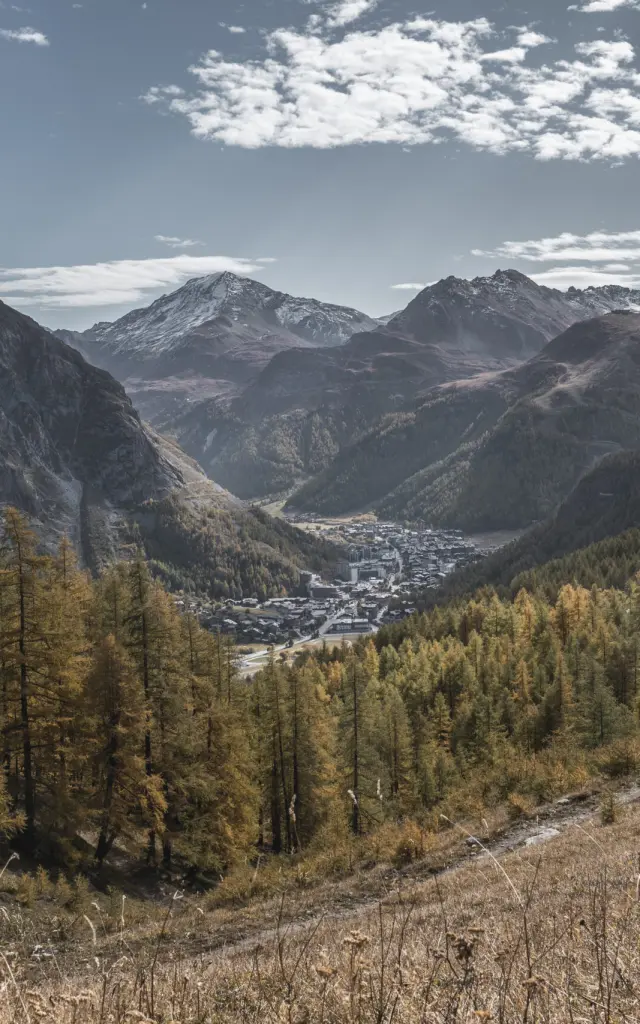
Louis: “I’m glad to be in Val d’Isère rather than in the city. Here, there are mountains, greenery and peace and quiet. In the city, tall buildings take the place of mountains.”
Léa: “I love the high altitude, getting away from it all, seeing different things. It’s always the same blocks of flats in town. In the mountains, it’s different – it changes every day!”
Louis: “For me, the most important thing to protect is the ski resort. I really enjoy skiing, and it attracts tourists and gives you the chance to meet people. Thanks to my ski lessons, I’ve met children from other parts of France and we’ve become friends.”
Léa: “I want to keep the animals – both pets and those that live outdoors – and to be able to pick fruit in the countryside and collect things… because all that makes you feel good and helps keep you in a good mood.”
As for ideas on what to change, they’ve got their own thoughts too.
Louis: “I’d like fewer blocks of flats and more chalets, like there used to be.”
Léa: “Yes, there’s more and more building work going on, so there are more houses. We’re getting crammed in more and more and we have less space to move about. We need to look after one another and look after nature, being careful not to throw away rubbish or cigarette ends.”
Louis: “We need to stop destroying the mountains to build houses. Let’s build hiking trails instead!”